Monday, 20 November 2017

Jerusalem: First Impressions (Part 2)

Here continues my alphabetical jumble of initial observations and thoughts from my first six days in Jerusalem.

Languages
Because of the gathering of nations, all kinds of languages can be heard. But the main languages are Hebrew, Arabic, and English. And in fact all the street signs are in those three languages. Which is helpful for trying to pick up again my reading of Hebrew script, for a start. So far I have only a handful of words in Hebrew or Arabic that I can speak.

Mary
What I said in the previous post about feeling closer to Jesus can mostly apply also to Mary. And her imprint on Jerusalem is more marked than I expected, with shrines marking the (reputed) places where she was born, died, and was buried. She’s no bit-player. Even the imam who gave me a copy of the Qur’an encouraged me to start with the chapter headed ‘Mary’.

Muslims
Islam is also no bit-player in Jerusalem. After all, the city was under Muslim control for most of the last 14 centuries. There is still a large Muslim population in the Old City, and pilgrims come to the Dome of the Rock from all over the world. Other sites, like the place of Christ’s ascension, remain in Muslim hands.

Olive
There are olive trees all over the place, although there isn’t much room for them in the more crowded parts of the Old City, as well as olive oil, olives themselves, and items made of olive wood. I’m here at the end of the olive season, and I was sad to see that the olive trees in the parks are just left to shed their fruit on the ground.


Peace
‘Jerusalem’ means ‘tower of peace’; but for much of its history it has not lived up to its name. The shadow of war still looms over the city. I didn’t at first see many soldiers around, but that changed over the last couple of days (I’m not sure why), and there is always a strong police presence. From little monuments around the place, and overheard commentary from tour guides, I also gather that the recent military history of Jerusalem is very significant for the Jews. They (or many of them, anyway) see the current situation as the result of a war of independence and liberation. But, like everyone else, they realise that war isn’t quite over yet. The day-to-day reality in Jerusalem itself is people living side-by-side in peace, and that holds out a hope of what might be possible. But it’s a wary peace.

Sabbath
I thought that Sabbath would be a very quiet day. But while most businesses would be closed, there were plenty of people out and about. It seems the Sabbath is a day for families to go out walking together. And in the Old City most of the shops were still open, run as they were by Muslims or Christians. With each religion having a different day off, the city never really stops.

Sparrows
Plenty of sparrows around, which keeps bringing to my mind the words, “Even the sparrow herself finds a home…” So it was especially delightful to see some of them chirruping and flying in and out of the bushes that grow on the Western Wall, all that remains of the Temple.

Sunday
Because of Muslim Friday prayers and the Sabbath on Saturday, Sunday is like Monday – the beginning of the working week.

Warmth
Daily temperatures have been consistently around 20C, and it doesn’t get particularly cold at night. Apparently some sort of winter will get here eventually, but right now it isn’t much different from summer for me.

Water
Although we have water on tap, and there is a lot of greenery around, there are reminders that water is a scarce resource. Like the general dryness of non-irrigated land (even the cacti are looking rather sorry for themselves) and signs warning us that the parks are irrigated with effluents. Along with the knowledge that the Dead Sea and the Sea of Galilee are shrinking due to irrigation, and that Palestinians don’t get their fair share of this resource, I feel quite conscious of all the water I use.

Western Wall
I enjoyed my visit to the Western Wall, although I was slightly disappointed that it didn’t live up to its popular name, ‘the Wailing Wall’. It was intriguing to see some structure that I could be certain Jesus had also seen and maybe even touched. But I wasn’t inclined to go up and touch it myself, still less to leave a prayer in the crevices of the wall, as is the custom. I just felt that that is for the Jews. Our Temple is something other. And again a verse of Scripture came to my mind: “You see all these buildings? I tell you that not one stone will be left standing on another.”

UPDATE: After two months in Jerusalem I have done a post correcting some of the above first impressions. You can read it here.

Jerusalem: First Impressions (Part 1)


Well, I’ve been here for six days now. For many a pilgrim to the Holy Land, that’s all the time they’d get to acquaint themselves with Jerusalem. But I’ll be here until August next year, God willing. So at the moment I am just garnering some initial impressions, which at the moment are half-formed and rather subjective. They will also be limited by the fact that so far I’ve not even seen all of Jerusalem’s holy sites, never mind gone across the border to Bethlehem or places like that. I’m letting myself take it slowly, and these reflections are offered as a beginning, not as a complete article.

Yesterday morning, while I was sitting in the Basilica of the Holy Sepulchre, quietly watching the pilgrims queuing to see inside Jesus’ tomb, I was approached by one visitor who asked, “Excuse me, what is in there?” I smiled and replied, “Very importantly: nothing.” And that might be an overall sense of Jerusalem so far – a place where what’s not there can be as important, if not more important than, what is there.
So, here are some hastily-noted impressions, gathered under alphabetical headings in a vain attempt to disguise their otherwise disorganised nature.

Beggars
Very few of these. So far I have seen only two. This surprises me.

Brightness
The prevalent sunshine is unfamiliar for a man from the grey and damp island of Britain, especially in November. Combined with the tendency to build in the local light-coloured stone, the overall effect is quite bright. It makes the narrow streets of the Old City, which could be oppressive, actually feel light.

Cats
This could be a totally subjective impression; but I seem to be seeing more cats and less dogs than back home in Britain. The friary alone has three cats. But they don’t come into the house (or the church).

Chance meetings
In my visits to Rome I found that it was nearly impossible to go from one side to another of St Peter’s Square without meeting someone I know (or at least someone who knows me and whom I vaguely recognise). I kind of expected it would be the same in Jerusalem. But so far I haven’t run into anyone I know. I guess that shows that the people here are gathered from a much wider circle. On the other hand, half the people who’ve approached me to ask directions or other information have turned out to be British. I guess that shows that I look sufficiently British to make them think, “There’s someone who might understand me.”

City walls
The sturdy and complete walls of the Old City help the association with the city of Bible times, when the walls and gates were an important factor, both practically and symbolically. The likeness is slightly deceptive, however, in that the current walls enclose places that were once outside them (e.g. the place of the Crucifixion) and don’t include places that were once inside the city (e.g. David’s tomb). Jerusalem’s centre-of-gravity has shifted.

Cleanliness

Everything seems quite clean. The streets of the Old City are washed every morning and litter-pickers pass through during the day. I don’t know how they keep the buildings clean. Back in London the light stones mentioned above would soon become grimy.

Franciscans

It’s not that Franciscan friars are everywhere; but they are a very common sight, especially in and around the Old City. And of course there are plenty of other friars, monks, nuns, and sisters of various religious orders, and beards there are a-plenty too. So I’m in the unfamiliar position of being mostly unremarkable. Even for the new tourists and pilgrims I am only one strange religious creature among many.

Gentiles

“It shall come to pass in the latter days that the mountain of the house of the Lord shall be established as the highest of the mountains, and all the nations shall flow to it.” And it really is a gathering of the nations here. In a short space of time you can spot (or hear – often it’s the accent that gives them away) people from every continent. Except possibly Antarctica.

Holy Sepulchre

This basilica is the most important site for Christians, containing as it does the place of Jesus’ crucifixion and the place of His burial and resurrection. To be able to touch the (traditionally-reputed) rock upon which the Cross was erected was a sorrowful but also strangely sweet experience. Despite the vastly different setting (a busy and highly decorated church rather than a barren hilltop), I was briefly transported back two thousand years. Likewise for the place of the Resurrection, where everything changed for the world, to touch my forehead against it in gratitude also involved a flicker of awe.
Even before that, however, when I was outside the Edicule that contains the empty tomb, postponing a visit inside, the words of the angel, “He is not here, He has risen,” kept echoing in my mind. All those pilgrims were coming, not because Jesus is there, but because He is no longer there. Hence the further words of the angel: “Come and see the place where they laid Him.” In a similar way, when watching the international crowd shuffling forward to venerate the place of the crucifixion, the words that came to me were: “When I am lifted up from the earth, I shall draw all people to Myself.”
Hustle and bustle


The streets of Jerusalem and many of the holy places are far from reverentially quiet. There is constant conversation, the explanations of guides and questions of the pilgrims and tourists, the tears and the hymns of the faithful, and out on the streets the calling of the vendors, to say nothing of the constant jockeying for position and the taking of pictures. The Way of the Cross on Friday was particularly restless: no sooner had one station been visited and prayers said but we were off at speed among the crowds to the next station. Many people would be stopping to pray with us; but others would be pushing past, or simply carrying on chatting in the front of their shops. As one of the brothers pointed out, it would have been the same at the original Way of the Cross – no time to stop and think, and most people carrying on with their lives regardless.


Jesus

Unsurprisingly, going to these significant places in Jesus’ story and even simply walking in areas that He walked help me to feel closer to Him. I can understand Him a little better and feel that I’ve got more in common with Him. Paradoxically, however, visiting the holy places also increases my appreciation and awareness of His presence in other places. One of the effects of my first visit to the Holy Sepulchre was a desire to spend more time with Him in the Blessed Sacrament. “He is here, because He has risen.”

Jews
I’ve never seen so many Jews – after all, about 45% of the world’s Jewish population is concentrated in Israel – and they seem to come in all types, shapes, sizes, and skin colours. There is a typical ethnic appearance that a lot of the Jews share, but there’s plenty of variety on the outer parts of the bell curve. And of course, they also vary in religious convictions – from ultra-orthodox to non-believing.
Seeing so many Jews all together helped me to realise what a relief it must be for them, when they’ve spent the last two thousand years being a minority wherever they are, to actually be in a country that’s majority-Jewish. A bit like how Catholics from Britain feel when they visit Ireland, for example. I can see a bit more of how important the modern state of Israel is for the Jews, even without taking into account the significance of its particular geographical location.


Sunday, 19 June 2016

Why I'm In

I am glad to be a British citizen. And an Englishman. And a Midlander. And a native of Warwickshire. And a Coventrian. Patriotism can and does work on several levels. So I'm also glad to be a European. I've grown up as an EU citizen, and it's part of my identity.

I'm also a Christian, specifically a Catholic, which helps to give me a more universal viewpoint than might otherwise be the case ('catholicos' = 'all-encompassing'). Believing that every human being's fundamental value comes from being made in the image of God and redeemed by Jesus Christ puts other markers of identity in perspective (while not eliminating them – see above paragraph). And let's not forget that the EU flag is based on the twelve-star crown of the Blessed Virgin Mary.

Add to that the fact that I'm now a member of an international religious order, with members in most countries of the world, including Europe. The free movement of people within the EU is not only practically useful to us Capuchins – it also helps to strengthen our fundamental identity as brothers, regardless of nationality and race.

I'm also sympathetic to the original inspiration of the EU, which was to counteract the sad tendency of the European powers to be at war with each other every generation or so. It was in the aftermath of the Second World War that the idea was conceived to make the countries of Europe more interdependent through trade and therefore less likely to become antagonists. It's been over seventy years since the last major European war, so that idea might be working. I'm not claiming that leaving the EU will lead to World War III; but anything that furthers peace is not to be given up lightly.

This peace-making consideration has been reinforced for me by my recent visit to Ireland. The Irish are quite worried by the possibility of Brexit; not just because of the economic impact on them, but also because they fear a return to the bad old days of border controls between the Republic and Northern Ireland. The free movement between both parts of Ireland has considerably helped the peace process.

All of the above is in order to briefly explain why I'm in principle and almost instinctively in favour of the UK remaining in the EU. And that means that during the course of the referendum debate I've tended to see the burden of proof as lying with the Leave campaign. If there are practical disadvantages to our membership of the EU that might outweigh the principled reasons for remaining, I've been willing to listen. So far, however, the Brexiteers are nowhere near convincing me.

I'll deal with the economics argument first, not because it's most important but because it's been most prominent in the debate. Economics has always seemed something of a dark art to me, so like most voters I'm left confused by the arguments being played back and forth. But the fact that many if not most businessmen and economists warn against Brexit suggests to me that the economic advantages to leaving are at least doubtful. And as a complete amateur, I would think that free movement of goods is bound to be good for trade on the whole.

Another major area of concern is about the effects of immigration. I think this whole area can be summarised under two headings: economic and cultural. The economic concern is that immigrants take jobs from British people and put pressure on housing and public services. On the other hand, many immigrants take jobs which British people don't seem to want (e.g. working in care homes or fruit-picking in our fields) or for which we don't have enough qualified people (e.g. nursing). By the same token, houses are being built and hospitals staffed by immigrants – think what a pressure our system would be under without them. In fact, even the Leave campaigners admit that high levels of immigration would have to continue, because the UK needs people of working-age to fill the demographic gap from decades of low birth-rate. When analysed closely, the Leave campaign's real point is to be able to 'control' immigration. I will touch further upon this whole issue of 'taking back control' a bit later. But for now I note that I don't see any evidence that immigration is badly out of control – rather, as just noted, the immigrants are mostly doing good work. Furthermore, the free movement of people is a two-way street, which many British citizens have been able to take advantage of.

The cultural impact of immigration is one for which I have more sympathy. It is undoubtedly true that it's harder to maintain our British culture when large numbers of people from other cultures are moving in. I would submit, however, that immigrants still form a small minority of our population, so a healthy culture shouldn't have any trouble integrating them. The problem is that British culture is not healthy, partly because of a growing historical illiteracy and partly through the loss of Christian faith. If we really want to protect our culture, those are the problems to address, along with the low birth-rate.

Another argument of the Brexiteers is that the EU is undemocratic. It is certainly true that European Commissioners are unelected; but there are several points to make about this. Firstly, the members of the European Parliament are elected. Secondly, the Commissioners are appointed by our elected representatives, so they are not far removed from democratic accountability. Thirdly, no one objects to judges, for example, being unelected – and in fact no system can practically run entirely on elected posts. Finally, Commissioners are unelected because the EU is a fundamentally a treaty between sovereign states, not a democracy in its own right. Anyone who wants to make the EU more democratic would have to move more towards the European super-state that people seem to so much dread.

The rhetoric about 'taking back control' doesn't impress me much. Imagine, for example, there was a move for my home town Coventry to 'take back control' from Westminster. Romantically though the notion of a city-state would appeal to me, I would want to ask what actual advantages it would bring. The reason Britain is not a collection of city-states or that England no longer consists of its original Anglo-Saxon kingdoms is that there are many advantages to becoming part of a greater whole. We transfer a lot of decision-making to that greater whole in return for those advantages. So any argument to reverse that process needs to clearly explain the benefits such a reversal would bring. Thus far I have seen nothing satisfactory in the way of such an explanation. The assumption often seems to be that 'taking back control' is automatically a good thing.

I also reflect that the 'control' currently wielded by the EU would return to a British Government which was elected by a minority of the British people and which I personally do not trust to act for the common good.

It's not as if the EU has that much control over us anyway. Most decisions that greatly affect us are taken at the national level. The electorate, I think, understand this in that they pay far more interest to a General Election than to European elections.

Another complaint against the EU is that it is grossly inefficient to the point of corruption. People on all sides seem to concede this point to at least some degree, so I won't contest it. But I will ask how inefficient the EU is in comparison to other levels of government, which often aren't particularly impressive either. With regard to other levels of government, we do not seek to abolish them because of their inefficiency or corruption; rather we seek to reform them. Why should we not do the same with the EU?

The Brexiteers have therefore failed to convince me that there are any major advantages to leaving the European Union. This is not least because no one is able to predict what actually will happen in the event of our leaving. But I also find the whole tenor of the Leave campaign distasteful, in that it has an overall attitude of 'Us and Them'. Whether 'They' are immigrants or faceless Eurocrats, the attitude is one of opposition to an outside enemy. I do not want a Britain based on that attitude.


To summarise: I have many principled reasons to remain in the EU, and I am wholly unconvinced that there are good practical reasons to leave.

Wednesday, 18 February 2015

On not being a thief in the night

On Ash Wednesday I often think of the following passage from 'The Fellowship of the Ring':

Putting [the horn] to his lips he blew a blast, and the echoes leapt from rock to rock, and all that heard that voice in Rivendell sprang to their feet.
'Slow should you be to wind that horn again, Boromir,' said Elrond, 'until you stand once more on the borders of your land, and dire need is on you.'
'Maybe,' said Boromir. 'But always I have let my horn cry at setting forth, and though thereafter we may walk in the shadows, I will not go forth as a thief in the night.'

The connection with this holy day may not be obvious. I first thought of this passage not because of the line 'Sound the trumpet in Zion!' in today's first reading (although I will gladly take it as further justification), but because of some reflection on an apparent contradiction in the liturgy of Ash Wednesday.

In the Gospel reading Jesus tells us to fast in secret, unlike the hypocrites who 'pull long faces to let men know they are fasting.' He tells us to 'wash your face, so that no one will know you are fasting...' And then a few minutes later we're all queuing up to get ash on our foreheads, so that we can all walk out of church with a big mark that says, 'I'm starting Lent!'

Not wanting to assume that we're all just ignoring Jesus, I tried to think how this fits together. And the above-quoted passage from Tolkien somehow came to mind. Because I think what we're doing in our Ash Wednesday liturgy is like Boromir blowing his horn as he sets off, even though prudence will keep him from doing so again for many days to come. The safety of our souls will keep us from advertising our penances to others during the season of Lent, lest we fall into pride and vanity; but as we begin the journey we encourage each other and declare our intent to remain steadfast through the trials.

The smudge of ash on my forehead declares that I stand with all my brothers and sisters who are embarking on the same quest. The penances we undertake may be known to each one alone, but the fact that we're in the battle together is publicly acknowledged.

As the Collect for the Mass puts it, 'Grant, O Lord, that we may begin with holy fasting this campaign of Christian service... as we take up battle against spiritual evils'. 'Sound the trumpet in Zion', because we will not go forth like thieves in the night!

Sunday, 18 January 2015

Book review: 'I Am Margaret'


Ever heard the phrase, "I can't do maths to save my life"? Well, imagine if your life really did depend on passing a maths exam... That's the situation faced by Margaret, the titular heroine of this book, the first published by my friend Corinna Turner.

Margaret lives in the not-too-distant and not-too-unbelievable future, in a society that has a utilitarian approach to people's value. As one character puts it, "the human race is made up of... useful people and useless people". Those deemed 'useless' do, however, have one contribution they can make to society: their body parts. Make that 'many contributions' - Corinna makes it clear for us that very few parts of the unfortunate 'reAssignees' are left to waste.

The distinction between the useful and the useless is made at age 18, when everyone goes through 'Sorting' - a series of tests in various subjects, as well as a measure of the person's physical fitness. Margaret Verrall, otherwise highly intelligent and healthy, has a mental block when it comes to maths, so she fails her Sorting. But her boyfriend, who passes his Sorting, has no intention of leaving her in the Facility, where reAssignees are prepared for 'dismantlement'.

Corinna has a gift for gripping narrative - the book took me along fascinated, most chapters ending in such a way that it took quite an effort of will not to carry on to the next chapter, and the next... Written from a first-person viewpoint, the story keeps us well-acquainted with Margaret's fears, hopes, and dreams (especially her dreams of Bane, her boyfriend and fiance). The writing is at turns eloquent and punchy, and mixes humour and tragedy. There are many pleasing turns of phrase, the most memorable for me being, "It felt like cutting my heart out with my tongue."

As in all good fiction, we are slowly introduced to the world of the characters, little details at various points helping to piece together the sub-creation's inner logic. It's not until quite a while into the book, for example, that we find out that cars run on hydrogen - an important detail in a world that's dealing with the after-effects of climate change - yet Corinna does not labour the point and leaves the reader to make the connection.

But the greatest and most frequent pleasure in reading this book came from another important element in Margaret's peril: she's a Christian. In reading fiction, I have often had in the back of my mind the realisation that the characters would act a whole lot differently if they were Christians and true disciples of Christ. There's a constant slight dissatisfaction that the attitude of faith is not portrayed in so much otherwise-good fiction. Imagine my thrill, therefore, to read of Christians realistically portrayed - Margaret's prayers, her moral dilemmas, and her fears are all quite believable. And moving: I was particularly touched by a scene in which Margaret receives Communion for the first time in ages.

I said that being a Christian adds to Margaret's peril - that's because belief in God is illegal, and carries the death penalty. She and her family have lived their lives in the fear of being found out by the authorities; a danger compounded by the fact that the family home is a secret Mass centre. That and many other details echo the situation of Catholics in England during 'penal times' - a parallel emphasised by a quote from St Margaret Clitherow, the English martyr, which prefixes the narrative. The martyrdom scenario is helpfully clarified by the fact that Christians (or indeed any other believers in God) can escape the death penalty simply by making 'the Divine Denial'. As a judge puts it, "What's four little words? There. Is. No. God. That's all you have to say."

The normal death penalty is to be 'dismantled' while unconscious; but those found guilty of 'Inciting and Promoting Superstition' do not have the luxury of being unconscious for the process. Which leads me to a small 'health warning' - this book is not for the faint of heart. While Corinna does not go into unnecessary detail, she leaves us in no doubt about the suffering and terror that some characters have to go through. Most of the story is set within the Facility, which adds a claustrophobic atmosphere to the trials of the heroine and her fellow-inmates. I found myself emotionally worn out by the time I finished the book, after a rollercoaster ride of feelings.

All this, however, continually poses questions for the believer: Would I be able to cope? Would I keep true to love of God and of neighbour when in mortal peril? Would I make the Divine Denial?

Without the faith element, I would probably have merely liked this book. With it, however, I loved it.

Another warning: this book is the first in a series of four, and if you read it you will want to read the next in the series - 'The Three Most Wanted'.

Friday, 5 October 2012

Visiting the Portiuncula

The General Chapter turned out to be a great experience: full of ups and downs, inspiring and frustrating, and not boring at all – despite being five weeks long. There will be plenty to share as I slowly digest it all over the coming weeks. But in this post I would like to start with a reflection on just a couple of incidents that gave me particular food for thought.

From small beginnings
On my last full day in Italy we travelled back to Rome from San Giovanni Rotondo – a long coach journey through varied terrain. While passing among the mountains I spotted a ruined chapel in the woods, and it occurred to me that if Francesco Bernadone has not answered his call, such might have been the chapel of San Damiano or the Portiuncula. They would be ruins in the forest, near to the small and unregarded town of Assisi.

Thanks be to God, St. Francis did obey the voice of Christ speaking to him in San Damiano. So now that chapel stands as key place of pilgrimage for the millions who visit Assisi. The Portiuncula, meanwhile, not only remains to welcome pilgrims, but is housed in the middle of a huge basilica. A wise woman, after her first trip to Assisi, remarked that the situation of the Portiuncula – a small, simple chapel enclosed by a grand, ornate basilica – is a parable of the Franciscan charism. And while that was said with a certain amount of sorrow at the lost simplicity of Franciscan beginnings, it helped me to understand some positive implications of the Chapter’s visit to the Portiuncula.

A worldwide brotherhood
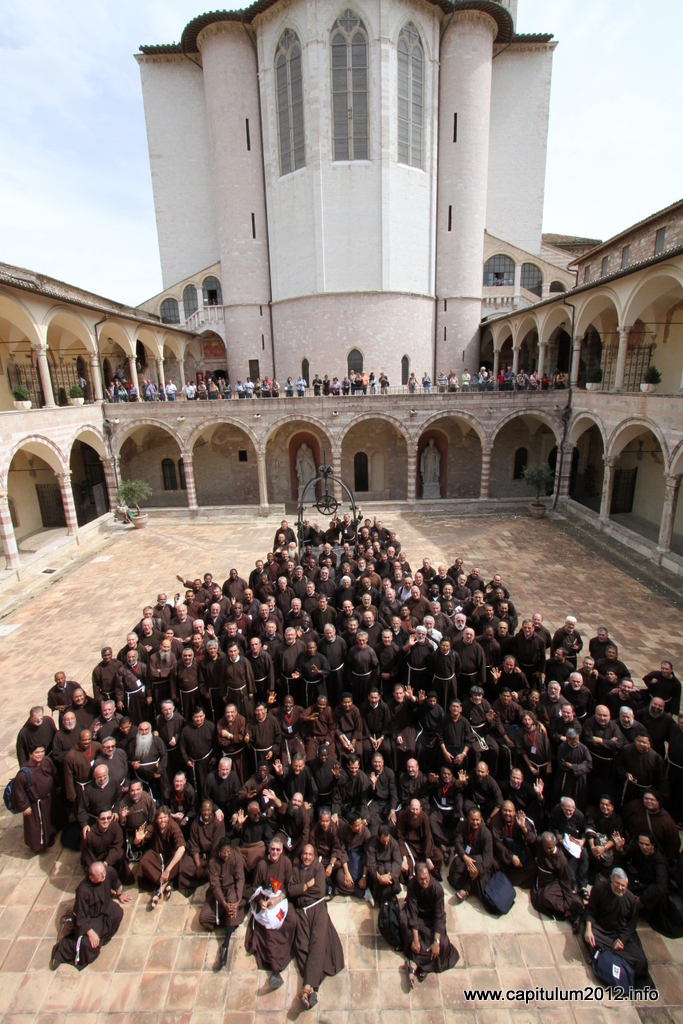
The brothers gathered at the Basilica of Our Lady of the Angels numbered a little less than two hundred; and yet, although we were less than 2% of the whole Capuchin Order, we could not in any way fit into the chapel of the Portiuncula. We had to gather in front of it for the liturgy celebrated there. But at the key part of the liturgy we did enter the little chapel, filing through only a few at a time, and then moving on out again into the vast space of the basilica. And as we passed through that place where the Order had its beginnings, the General presented each of us with a lighted candle, exhorting us to “Relight the flame of our charism!” Slowly, therefore, the church was filled with these little flames, each one coming from the little chapel at its heart.

I found this ceremony deeply significant. For a start, the very fact that we could not all fit into the Portiuncula was a reminder that we could not, as a whole Order, go back to the lifestyle of St. Francis and his first companions. We have grown beyond that – even in Francis’ lifetime we had grown beyond that. The huge diversity of Capuchin conditions and ministries today, and the developments of the world, cannot be fitted into that original manner of living the Gospel.

On the other hand, as the General’s gesture showed, we not only can, but we must enter somehow into that original experience if we are to renew our Franciscan life. The flame of our 21st-century charism must be lit from the flame of the 13th-century. What is needed is that desire for 'ressourcement', for a return to the sources, which the Second Vatican Council asked of religious orders, lest our life be completely detached from our founder and drift more and more into worldly ways. And this return to the sources cannot be merely an intellectual experience, but needs also to be a lived reality, a true entering-into our beginnings.

Living the dream
Just as the friars at the Chapter had to file through the Portiuncula a few at a time, so we in the British Province have to take turns to revisit the life of St. Francis and his brothers. As we are thus renewed, we take our rekindled spirits back into the wider fraternity. In fact, one such recurrent experience is already written into our Capuchin life. I refer to the annual retreat, which is a chance to enter again the Portiuncula of prayer, that prayer so foundational to Francis’ life and the life of the first Capuchins. We light again the flame of our contemplative life, and bring it back with us into our fraternities.

In our Province we have been blessed with more extended and more communal visits to the Portiuncula. The friaries at Penmaenmawr, Hollington, and Preston were returns – although only partial returns, it is true – to the primitive manner of Franciscan life, each fraternity developing a different take on that life. Those of us who lived in or otherwise experienced those fraternities have been granted a fresh vision of what is possible, and have carried this flame into the next stage of our Capuchin life.

Many friars can name experiences which have reconnected them to the primitive charism. Now, however, we will turn our minds to other possibilities, to new ways in which friars can enter – a few at a time – our humble beginnings. These ways may be quite similar to recent ventures, or they may be more innovative. We might take a cue from Cantalamessa’s talk at the 2009 Chapter of Mats and focus on experiences of prayer, poverty, and preaching – which he identified as foundational elements of the Franciscan charism. Or we might take our inspiration from other elements, such as Francis’ service to the lepers, which he desired to return to at the end of his life.

Our ongoing formation programme during these 3 years is an opportunity to renew our basic understanding of our Franciscan life, as we reflect on the first sentence of the Rule. We will also reflect on what lived responses that understanding calls for, what ways we can revisit the Portiuncula and the flame of our charism.

The Lord is in charge
We often lack imagination to see the ways forward and are slow to take up the challenges involved. So it may be that Lord in His mercy will place us in the necessary situations, where our only choice will be whether or not to embrace the experience. I am thinking particularly of an inspiring anecdote in the General Minister’s report, with which I will conclude:

“A few days before Easter 2009, Abruzzo (Italy) and in particular the city of Aquila, was struck by a devastating earthquake which claimed many lives. Many parts of our own friary were badly damaged, and it would have been easy enough for our brothers to find hospitality in one of the other friaries of the province. But the friars of Abruzzo decided to stay put, sharing the same conditions as those who had nowhere else to go. I went to visit them! There they were, living in tents or in the compartment of a railway carriage, lining up to get food from the field kitchen, and never once did they cease to make the Lord present by celebrating Mass in the tent they had been assigned.”

Saturday, 23 June 2012

The Society of Pope Paul VI

On the letters pages of the latest edition of The Tablet, a correspondent notes that "There's something for almost everyone [in today's Catholic Church], what with the Tridentine/Latin Mass cohort, the ordinariate, and now the proposed Society of St Pius X personal prelature." She goes on to suggest that other Catholics need to "grab a label or two if they are to be noticed and survive", and she observes that "the Vatican II movement... remains curiously, uniquely, unblessed by Rome."

I think this is an excellent point, and it links with a suggestion I've often made to those who are disgruntled with the current Pope's policies – especially things like his overtures to the Society of St. Pius X or the promulgation of the new English translation of the Missal. I suggest that all proponents of 'the spirit of Vatican II' should come together to form the Society of Pope Paul VI. The English-speaking members of this society would be particularly distinguished by their insistence on preserving the purity of the 1973 English translation, and will hold popular Masses using the Missal of Pope Paul VI, with the congregations defiantly shouting the time-honoured response, "And also with you!"

Hopefully, the leader of this Society will be a bishop; because then, in his concern over Pope Benedict's policy of appointing conservative bishops everywhere, he will unilaterally consecrate a few bishops who can preserve the spirit of Vatican II, and thus be promptly excommunicated. The Society will then spend a few decades on the fringes of the Church, but enjoying a much higher profile than its numbers would seem to merit.

Eventually, a more liberal-leaning Pope will welcome the Society of Pope Paul VI back into the fold, much to the chagrin of mainstream Catholics, who will see this as a backwards step.